Hardwood · Utah guide
Wet Hardwood Floors in Utah: When Drying Works and When It Doesn't
Hardwood is the one common floor covering that can look ruined and still be saved, or look fine and be quietly failing underneath. The difference is measured in moisture content, not in how the boards feel underfoot.
Key takeaways
- Solid hardwood can often be dried in place; the decision is made with moisture readings, not appearance.
- Cupping means the top of the board is drying faster than the bottom. Mild cupping can flatten; severe cupping usually will not.
- Clean water found within a day is the best-case scenario. Contaminated water or a week-old leak changes the answer.
- Utah's dry air helps surface drying and hides the problem: the subfloor and wall base can stay wet long after the boards feel dry.
- Photograph the source, the water line, and the floor before extraction begins. That record supports the claim.
What water actually does to a hardwood floor
Wood is hygroscopic. It takes moisture out of the air and out of anything it touches, and it swells as it does. A finished floor board is a sandwich of layers: the finish on top, the wood in the middle, and the subfloor or underlayment below. Water rarely wets all of them evenly, and that unevenness is what causes most of the visible damage.
When a supply line lets go, water often enters at a wall and spreads under the floor before it shows on top. The board edges absorb first, which is why the seams cup upward while the center of the room still looks normal. If the water came from below, through a slab or a crawlspace, the bottom of the board swells first and the finished face may stay flat until the damage is advanced.
This is also why a floor can feel dry and still be wet. The surface dries in hours in Utah's low humidity. The subfloor, the bottom of the board, and the wall cavity behind the baseboard can hold moisture for days.
Cupping, crowning, and buckling: what the shape means
Cupping is the classic shape: the edges of each board rise and the center dips, giving the floor a washboard texture. It happens when the top dries faster than the bottom. Mild cupping is a normal early response and can flatten again as the whole assembly equalizes under controlled drying.
Crowning is the opposite: the center of the board rises above the edges. It usually means the floor was sanded while it was still cupped, or that the surface was dried too aggressively while the bottom stayed wet. Crowning is much harder to reverse and often ends in replacement or a full sand-and-refinish.
Buckling is the floor lifting off the subfloor in sheets or ridges. That is a structural failure, not a surface problem. It usually means the wood expanded against a wall or a fixed object with nowhere to go. Buckled boards generally have to come up.
The first 24 hours: what helps, what hurts
Shut off the water source first, then stop the water from spreading. Towels and a wet/dry vacuum can remove surface water, but do not use a household vacuum with a cord in standing water and do not walk across a floor that may be near an energized outlet. If the water reached the electrical panel, stay out of the room.
Lift loose rugs and furniture legs immediately. Furniture sitting on wet boards traps moisture against the finish and leaves a permanent mark. Move cardboard and paper out first because they wick and stain. Do not pull up attached flooring or baseboards before the damage is documented; the removal line is a decision for a moisture reading and an adjuster.
Do not aim a space heater at the floor. Rapid heat dries the surface faster than the core, which is exactly how cupping becomes permanent. The goal is even, controlled drying, not speed.
How professional hardwood drying works
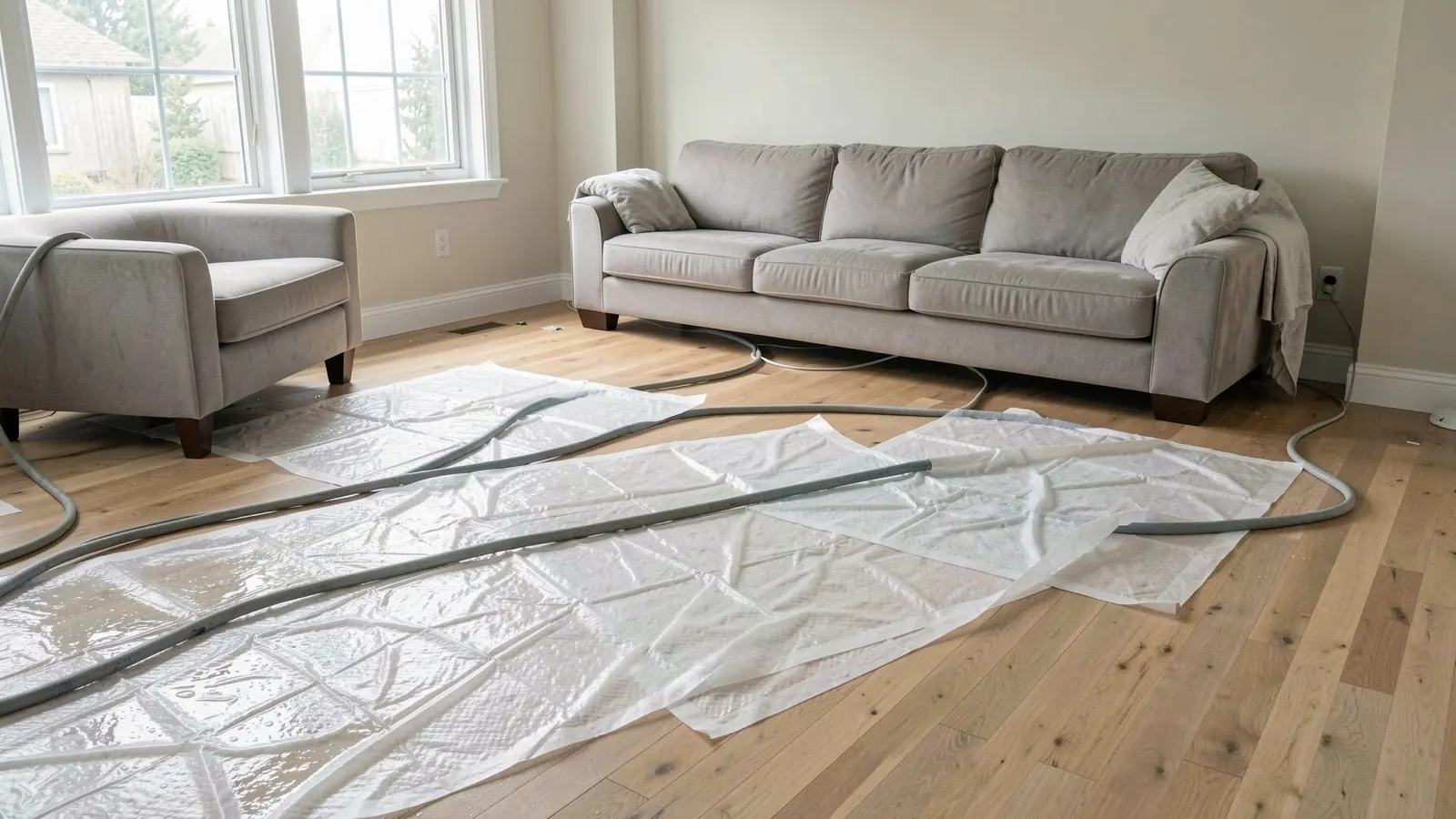
The equipment is not just a fan and a dehumidifier. The floor is treated as part of an assembly. Technicians take moisture readings at the surface, at the board edges, at the subfloor, and along the wall base, then set a drying goal for each material. Air movers keep the air moving, dehumidifiers pull moisture out of the room, and specially designed drying mats are sealed to the floor to draw moisture out of the boards without overheating them.
The mats work like a controlled suction cup. A hose pulls moist air from under the mat while the room dehumidifier removes that moisture from the air. This lets the boards dry from the top down at a rate that matches the bottom, which is what prevents permanent cupping. The process is slower than most homeowners expect: several days, with readings logged daily, and equipment left in place until the numbers say the assembly is dry.
In a finished basement or a main floor above a crawlspace, the technician also has to check the cavity below. Drying the visible floor while the subfloor stays wet just moves the problem. A basement water damage assessment may be needed at the same time.
When replacement is the honest answer
Drying is not always the right call, and a contractor who promises to save every floor is not giving you an honest scope. Replacement is usually the better answer when:
- The water was contaminated. Sewage, groundwater, and flood water carry material that cannot be cleaned out of the seams and the subfloor.
- The boards are laminate or some engineered products. Many laminate cores swell and never return to their original thickness.
- The floor has buckled or crowned. The shape change is already structural, and sanding will not restore a flat surface.
- Growth has started underneath. Mold on the subfloor or the back of the boards changes the scope from drying to removal and remediation.
- The leak ran for a week or more. Long saturation weakens the finish and the adhesive, even if the boards look intact.
Replacement does not always mean the whole floor. A skilled scope can often stop at a natural break: a doorway, a transition strip, or the edge of the affected room. The goal is to match the existing floor and keep the repair defensible for the claim.
Utah conditions that change the decision
Three local patterns come up on Utah calls. The first is winter: a frozen supply line behind a kitchen wall can release water for hours before anyone wakes up. The floor may be wet under the cabinets and along the wall long before the center of the room shows a stain.
The second is dry air. Utah homes run low humidity in winter, and forced-air heat pulls moisture out of the surface fast. That makes the floor feel dry while the subfloor stays wet. It also makes cupping more likely, because the top dries faster than the bottom.
The third is the slab. Radiant heat and slab-on-grade construction are common in newer Utah homes. A slab releases water slowly, and a hardwood floor glued or floated over it can stay damp for a long time. Drying a slab assembly is a different job from drying a plywood subfloor over a crawlspace, and it needs readings at the concrete, not just the wood.
Homes in Salt Lake City, Provo, and St. George face different versions of the same problem: freeze splits in the north, snowmelt and canyon runoff along the Wasatch Front, and monsoon-driven leaks in the south. The floor responds the same way; the source and the season change the plan.
What your adjuster needs from a wet floor claim
Adjusters work from evidence, not adjectives. Before anything is removed, photograph the source, the water line on the wall or cabinet, and the floor from several angles. Note the date and time the water was found. Keep a sample of the damaged material if removal is necessary, and ask for the moisture readings in writing.
The drying log matters as much as the initial photos. It shows that the floor was monitored, that equipment was sized to the wet area, and that the dry standard was reached before the repair was closed out. For a deeper walkthrough, see drying logs and moisture readings.
Frequently asked questions
Can wet hardwood floors be saved after a leak?
Often yes, if the water was clean, the leak was found quickly, and the boards are solid wood with a finish that is still intact. The earlier drying starts, the better the odds. A floor that has been wet for days, or that took contaminated water, is usually a removal and replacement job.
How long does hardwood floor drying take?
A typical hardwood dry-out runs several days longer than carpet or drywall because the mats have to draw moisture through the boards and the subfloor slowly. Readings are taken daily and the equipment stays until the wood and the assembly below reach a dry standard. Rushing the schedule is how cupped boards get closed up wet.
Does homeowners insurance cover hardwood floor water damage?
A sudden and accidental release, such as a burst supply line or a failed appliance hose, is usually covered, including the drying and the replacement if replacement is necessary. Groundwater seepage and rising flood water generally are not covered and need separate flood insurance. Photograph the source, the water line, and the floor before anything moves.
Will my floor always cup after getting wet?
Not always. Cupping is the board edges rising above the center as the top dries faster than the bottom. Mild cupping can flatten again as the whole assembly equalizes under controlled drying. Severe cupping, crowning, buckling, or boards that stay raised after drying has finished usually mean the floor will not return to a flat, finished surface.
Can I run a household dehumidifier and fans instead of calling?
For a small spill on a sealed floor, a fan and a dehumidifier can help if you start immediately. The limitation is verification: without moisture readings you cannot tell whether water reached the subfloor, the wall base, or the cavity below. That hidden moisture is what produces cupping, mold, and a failed finish weeks later.
Related guides
Keep going with the Utah-specific guides homeowners read next.
-
The First Hour After Water Damage
What to shut off, photograph, and leave alone before the crew arrives.
-
Hidden Water Damage Signs
The quiet clues that water is still moving under floors and behind walls.
-
Drying Logs and Moisture Readings
How daily readings become the evidence behind a successful claim.
Wet Floor and Not Sure What to Do?
Call and describe the source, the room, and how long the water has been there. The dispatcher will confirm coverage for your ZIP code and contact the closest available crew.
Call (844) 609-3645