Basement · Utah guide
Snowmelt and Basement Seepage in Utah: A Spring Checklist
The first warm week after a deep Wasatch winter is the busiest stretch of the year for Utah basement calls. The water is not usually a plumbing failure. It is the snowpack releasing all at once, and it follows the same slope the house was built into.
Key takeaways
- Spring basement water in Utah usually arrives from the uphill side, not up through the floor.
- Clay soil, frozen ground, and a fast thaw can overwhelm a foundation drain that handles a normal rain.
- Clear window wells and test the sump pump before the first warm week, not after the carpet is wet.
- Groundwater seepage is generally not covered by a standard homeowners policy; a sudden pipe failure usually is.
- Drying a basement means drying the wall cavity and the floor assembly, not just the visible floor.
Why Utah basements seep in spring
A Utah spring is a plumbing event disguised as weather. The ground is still cold and partly frozen when the first warm days arrive, so meltwater cannot soak in. It runs along the surface, collects against the uphill foundation wall, and pushes into the first crack or joint it can find. The same bench that gives a home its view gives the water a reason to arrive.
Three conditions line up. The snowpack holds a lot of water. The soil is often clay-heavy and slow to drain. And the foundation drain, if there is one, may be old, clogged, or undersized for a fast melt. When all three meet, a basement that stayed dry through a wet October can take on water in a single March week.
Southern Utah has a different version of the same story. There the spring melt is smaller, but the ground is steeper and the soil is thinner. Water reaches the foundation faster, and a monsoon-style burst in early summer can do the same thing in an hour.
First, identify the source
The fix is different for each source, so identify it before anyone starts cutting drywall. Three patterns cover most calls.
Plumbing. A supply line, water heater, washing machine hose, or floor drain. The water often appears near a fixture, arrives suddenly, and may be clean or sudsy. Shut off the main valve and call. This is the category most likely to be covered by a homeowners policy.
Surface water. Meltwater or rain that runs across the yard, fills a window well, and enters at a door or a well. The entry point is usually high on the wall, and the water may be muddy. Clearing the well and grading away from the foundation matters as much as drying.
Groundwater. Hydrostatic pressure pushing water through the wall, the footing joint, or the slab. The water appears along a wall or at the base of the foundation, often after a few warm days. It may be clear, and it may come and go with the water table. This is the classic Utah spring seepage pattern.
The pre-thaw checklist
- Clear every window well. Remove leaves, ice, and debris, and confirm the drain at the bottom is open. A blocked well becomes an aquarium against the basement glass.
- Check the grade. Soil should slope away from the foundation for several feet. A low spot against the wall holds meltwater exactly where you do not want it.
- Extend the downspouts. Discharge should land well away from the foundation, not against the wall or into a window well.
- Test the sump pump. Pour a bucket of water into the pit and watch it start, pump, and shut off. Listen for a check valve that is stuck or a discharge line that is frozen.
- Look for cracks and efflorescence. A white powder on a block wall is a sign that water is moving through the masonry. Photograph it before the thaw.
- Move storage off the floor. Cardboard, holiday boxes, and rugs should sit on shelves or pallets, not on the slab.
- Check the floor drain. Make sure it is not covered by a rug or a finished floor, and confirm it drains rather than backs up.
- Have a plan for an empty house. If you travel during the thaw, ask someone to check the basement daily. A small seep caught on day one is a drying job; a week later it is a removal job.
When the water arrives: the first 24 hours
Safety first. Water and electricity are the combination that turns a property loss into an injury. If water has reached outlets, a freezer cord, a sump pump plug, or the panel, stay out of the space and call. Do not walk through standing water to flip a breaker.
If the water is clear of electrical equipment, move what you can reach from dry footing. Start with paper, cardboard, and anything that stains. Lift furniture legs onto blocks or foil. Do not pull up attached carpet or baseboards before the damage is photographed; the removal line should be decided with a moisture reading.
Use a wet/dry vacuum only on a grounded circuit and only away from standing water. A household vacuum is not designed for water and can shock or fail. If the water is rising or has reached the wall cavity, stop and call.
How a basement dry-out actually works
Extraction comes first. Standing water is pumped or vacuumed out, and saturated carpet, pad, and any loose material are removed if they cannot be dried. Then the structure is measured. A technician takes readings on the block or concrete wall, the bottom plate, the framing, the subfloor, and the visible floor. That map decides where the equipment goes.
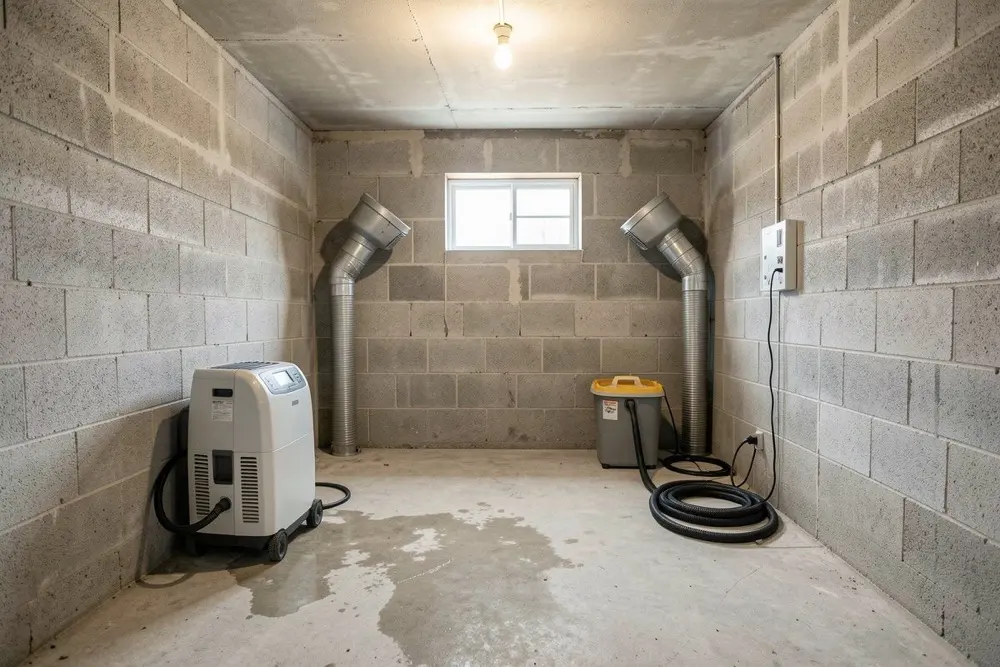
Air movers alone are not enough in a basement. The air has to be exchanged and dehumidified, or the moisture simply moves from the wall into the air and back again. In a finished basement, the wall cavity may need a drying system that pushes air behind the drywall without cutting it open. In an unfinished basement, the block wall and the floor assembly are dried directly.
The job ends on readings, not on appearance. A basement floor can look dry while the bottom plate and the insulation behind it stay wet for days. That hidden moisture is what produces the musty smell and the mold call a month later. For the documentation side, see drying logs and moisture readings.
What not to do
Do not paint over a damp wall. The paint traps moisture and bubbles or peels within a season. Do not plug a weeping crack from the inside with hydraulic cement and call it fixed; the water will find another path, often farther along the wall. Do not run a space heater against a wet block wall to "bake it out." That drives moisture inward and can damage the masonry.
Do not ignore a musty smell because the floor is dry. Smell is a reading too. It usually means the wall cavity, the carpet pad, or a stored item is still wet. And do not throw away damaged material before it has been photographed and, if a claim is likely, seen by an adjuster.
Insurance: what usually responds
A sudden and accidental plumbing failure is typically covered: a burst supply line, a failed water heater, a washing machine hose. Groundwater that seeps through a foundation wall is generally excluded and needs separate flood coverage. Sump pump overflow and sewer backup usually require endorsements that many homeowners do not realize they declined.
The source decides the claim, so document it carefully. Photograph the entry point, the water line, and the damaged material before anything moves. Keep the receipts for any emergency mitigation and ask for the moisture readings in writing. For a fuller explanation, see does homeowners insurance cover water damage.
Local patterns worth knowing
Along the Wasatch bench, the uphill wall is the usual suspect: snowmelt runs down the slope, collects in the soil, and pushes through the block. In Cache Valley and the northern valleys, a late freeze can keep the ground sealed while the top layer thaws, so water runs across the surface instead of soaking in. In St. George and Washington County, the spring melt is less of a factor, but a monsoon burst can fill a window well or a dry wash in minutes.
The common thread is that the water arrives from outside the footprint of the house. That is why a basement page is never only about the basement. It is about the yard, the grade, the well, the drain, and the wall. If you are in Sandy, Lehi, or Logan, the city guide lists the local soil and slope patterns that show up on calls.
Frequently asked questions
Why does my Utah basement leak every spring?
The usual pattern is snowmelt running down the bench and soaking the ground against the uphill foundation wall. Hydrostatic pressure pushes water through cracks, the joint where the wall meets the footing, and window wells. Clay-heavy soil makes it worse because it drains slowly. A second pattern is a failed drain tile or sump pump that cannot keep up with the spring volume.
Is spring basement water covered by homeowners insurance?
Groundwater that seeps through a foundation wall is generally excluded from a standard homeowners policy. A sudden plumbing failure, such as a burst supply line, is usually covered. Sump pump overflow and sewer backup usually require specific endorsements. Photograph the entry point and the water line, and call your agent before assuming either way.
How long does it take to dry a wet basement?
Most basement dry-outs run three to five days, longer when the walls are block or poured concrete and the insulation or framing stayed wet. Drying ends when moisture readings in the wall cavity, the floor assembly, and the framing reach the dry standard. The visible floor drying first does not mean the room is dry.
Can I just run a fan and open the windows?
In dry Utah air, a fan can dry the surface, but it cannot pull moisture out of a block wall or a wall cavity. Opening windows in early spring can also bring more moisture in if the outside air is warmer and wetter than the basement. The reliable approach is extraction, air movement, dehumidification, and readings.
What should I check before the thaw?
Clear window wells and the area drains near them, check that downspouts discharge well away from the foundation, test the sump pump with a bucket of water, look for cracks or efflorescence on the foundation wall, and move stored items off the floor. If the house will be empty during the thaw, have someone check the basement daily.
Related guides
Keep going with the Utah-specific guides homeowners read next.
-
The First Hour After Water Damage
What to shut off, photograph, and leave alone while help is on the way.
-
Hidden Water Damage Signs
The quiet clues that a wall cavity is still wet after the floor looks dry.
-
Preventing Winter Water Damage in Utah
The freeze checklist that keeps a spring seep from becoming a burst line.
Water Coming Through the Foundation Wall?
Call and describe where the water is entering and how deep it is. The dispatcher will confirm coverage for your address and contact the closest available basement crew.
Call (844) 609-3645